Mistaken Eye-dentity

This time, it happened as I was exiting my car and walking towards an office building for a meeting.

“How many trucks do you have, Leonard?,” this 40-ish looking man, standing in front of the office doors, shouted at me enthusiastically.

I didn’t recognize him.  I turned around to see if he was talking to someone behind me.  No one.  When I approached the doors, he ovaled his arms to give me a hug, but when I stepped back, he stopped short, his hands suspended in the air like he was dancing with an invisible partner.

“Oh I’m sorry,” he said.  His hands deflated to his sides.  “You looked like an Asian guy I know.”

The time before this, I was changing in the locker room, when a man came up to me and buddy punched me.

“Hey man, long time no see!”

“I’m sorry, but I think you got the wrong guy.”

“No way, you don’t remember me?  I’m your massage therapist.”

“I’m sorry, but I think you got the wrong guy.”

“No way man.  I remember you.  You need to book another appointment!”

His insistence made me wonder, for a slight second, if he indeed was my massage therapist, but I knew I never met the man.

“I’m sorry, but I think you got the wrong guy.”

“You’re sure it wasn’t you?  It was an Asian guy,” he told me assuredly, almost as if I needed reminding.  I finished dressing and walked out.

Millions of Asians worldwide and I just happen to look like every one of them.  People see my eyes, my hair, my skin color and instantly I’m the Asian they’ve seen on TV, the Asian they work with or the Asian they went to school with.  I never knew I had the universal Asian face.  This must be the reason why I’m the subject of so many cases of mistaken eye-dentity.  Because if it wasn’t for my eyes, how would they link me to an entire race?

Recently, I was at my company’s Christmas dinner and while I was sitting at the table, one of my co-workers mistook me for Bohn, the other Asian in the office.

“Hey Bohn,” she said to me.

Everybody at the table looked at her, then at me.  No one corrected her.  Perhaps she just confused our names, but then she continued.

“Bohn, who’s that guy sitting next to Mary Ann?”

The guy she was referring to was actually Bohn’s co-worker.

“That’s Sean,” I said.  “He works with Bohn.”

She glared at me.  The confusion switch flipped on.  At first, I wasn’t sure if she thought I was the type of person who referred to myself in the third person.

When Bohn talks, Bohn likes to address himself as Bohn.

But then it dawned on her, that perhaps I wasn’t Bohn.

Bohn and I are roughly the same height, but that’s where the similarity ends.  His hair is almost shaven, while mine is spiky with a punk silhouette.  His skin tone is darker.  He’s more rotund.  He’s Cambodian.

In my opinion, we look nothing alike, but the fact that we are both Asians made us indistinguishable.  When I left the table, still unconvinced, my confused co-worker turned to the table and asked, “That’s not Bohn?”

I know people have cases of mistaken identities all the time, but the frequency of it happening to me is quite high.  Is this just an Asian phenomenon?  After all, Asians have amassed a worldwide population of almost four billion.  I’m bound to remind someone of an Asian they know.  But the curious fact is that not one Asian has confused me for another.  Do Asians see the differences that are obvious to us, but are subtle, if not invisible, to non-Asians?  Perhaps it’s the same way specialists discern stripe or spot patterns in tigers and leopards.

When other co-workers approached me a couple of days after the Christmas party, they were still tee-heeing about the incident.  “At least she got the Asian part right,” I told them.  If she had confused me with Sheldon, my black co-worker, then perhaps then I might be slightly worried.

Worried not for me, but for Sheldon.

After all, can he handle being the poster boy for the Asian community?



Share

The Night of the Gun

Night-of-the-Gun_l

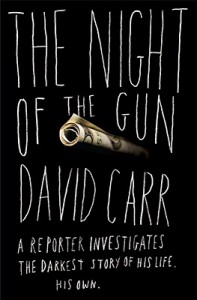
Initially, David Carr’s The Night of the Gun wasn’t a book I thought I would be interested in reading.  First, the title is very Soprano-ish, second, it’s another addiction memoir and third, it’s expansive (almost 400 pages).  As I started to read, I discovered that, yes the book was about his epic battle with cocaine and crack, but what I found more interesting was his attention to the fragility of memory.  How our memories, even the ones we believe as solid and unbreakable, can be nothing more than our attempts to hide our personal demons propagated with our desires to be someone else, someone better.  Such was the case on the night of the gun.  Carr steadfastly believed that on this night of binge drinking and cocaine indulging, his friend pointed a gun at him to make him vacate his friend’s apartment.  But when Carr dug deeper, it turned out his friend wasn’t the one with the gun, but Carr who wielded the .38 Special.  That false memory was the tipping point for Carr’s book.  As Carr stated, But if I was wrong about the gun, what else was I wrong about?

Thus began Carr’s journey, well actually more like in-depth reporting, on as what he dubbed as the darkest story of his life.  As impressive as his writing was, it was not as impressive as his exhaustive reporting, documenting, video recording and transcribing of all his interviews.  In the end, he recorded 19.3 gigabytes worth of material.  Astonishing.  All of this because he couldn’t trust his memory.  He wanted to get the real story, not just his version of what he believed happened.  He even hired an investigator to follow up behind him, just in case he missed any key facts.  For him, Memoir is a very personal form of creation myth, and perhaps less and less truthful.

That’s what made this book brilliant.  Instead of just writing about his struggle and the eventual overcoming of his addiction, Carr allowed the reader to step into his mind, to get his perspective and then flipped that perspective around, giving the reader the real truth, the really oh shit moment that truly happened.  By doing this, the reader can’t help but trust that Carr is giving them the rawest, most truthful account he can provide.  A couple of years ago, I read Augusten Burrough’s Dry and I thought it was a good book, although a tad bit sensationalized, about his own struggle with addiction.  After reading Carr’s book, I now wonder about the validity of Burrough’s recollection.  Burroughs didn’t do as nearly as much reporting as Carr did.  Honestly, it’s not just Burrough’s memory that has left me in doubt, but my own as well.  Carr’s book makes me question the accuracy of my memory and if what I’m writing about is really the truth, the whole truth and nothing but the truth.  The only way to tell, as Carr proved, is to dig deeper, to ask those uncomfortable questions and to listen to what actually transpired.

After reading this book, I’m left with the impression, that when writing a memoir, it’s important to choose the right story but more importantly, if not more, it’s getting that story right.

Share

You’ve fallen and I can’t stop laughing

fallingI have an admission.

It’s not something I am proud of but, as the old adage goes, the first step in solving a problem is to admit you have one.

So here it is. I laugh when people fall.

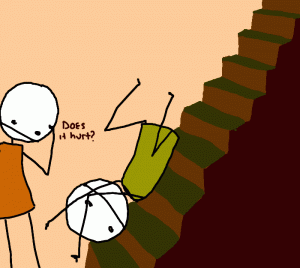
I don’t mean a slight snicker but a jackknifing so hard, I get whiplash.  Someone could trip from a bump in the sidewalk and I will laugh so violently, my convulsions could be mistaken as seizures.  I don’t know why I find falling, tripping, sliding, face planting and bum crashing down right hilarious.  Actually, I don’t limit my outbreaks to the lower extremities, anyone stubbing their fingers, bumping their funny bones, going face forward into a glass door all get the same reaction: me holding my sides, tears streaming down my face, yukking so loudly, people stop what they’re doing and stare.  And if you think I only laugh at people, think again, animals are definitely fair game.

Now before you think I am this heartless, insensitive creature, I do want to clarify.  I do have the ability to discern the difference between fainting, collapsing or tumbling due to medical emergencies and I do act appropriately.  However, all bets are off if the person revives and manages to walk away, albeit limping.  Then, and only then, in my opinion, is it OK to laugh.

Once, when I was at dinner in a quasi-formal restaurant with a bunch of friends, we got on the subject of tattoos.  There were some debate about who had one, who wanted one and who wouldn’t be caught in hell with one.  The conversation steered towards the pain and the needles involved.  One of my friends, a State Trooper, mentioned casually he doesn’t like needles or anything blood related, in fact, the mere mentioning of either topic causes him to feel queasy.  With three to four years of Trooper experience, he’s a tall guy, at least 6’3, probably around 200 pounds, teetering on the slippery edge of being thirty, not overly muscular, but no couch potato either.   Sitting at the end of the table, he pleaded softly for us to change the topic.  Not taking him seriously, I carried on how the needles really didn’t hurt, how it felt like someone pressing the bristles of a hairbrush against my skin and that’s when it happened.  My friend’s eyes rolled back into his head like stuck numbers on a slot machine.  Before we could grab him, he fell face forward, intimately going to first base with the shag carpet.  His face dug deep in the carpet while his body teepeed up with his rear end flashing us.  Imagine a giant upside down V.  Of course, we all jumped up and ran to his side, flipped him over and began slapping his face.  His eyelids fluttered like the quick beats of a moth’s wings.  As he came to, he muttered incoherently, “What happened? Where am I?”  “On the floor,” I said, “You passed out”.  With the help of some cold water, he regained consciousness.  We quickly paid the bill, pulled the car around and carried him out.  Afterwards, he had a huge strawberry that skunk tailed down the front of his face.  He told his co-workers he got smacked with a branch while working in the yard.

The whole time I was in stitches.  First, the image of him – a State Trooper, face smooching carpet, ass up in the air – was hysterical.  Second, him lying supine in the middle of the restaurant, diners huddled over, managers frantically wanting to call 911 was something out of a comedy.  Third, because of his size, everything was exaggerated – the dramatic fall, the awkward positioning, the hunched over rescue.  Afterwards, each time I saw him, I would imitate a redwood tree falling.  Knee slapping, eyes watering, I would guffaw like a barking seal when I was done.  He didn’t find it very amusing, nor did my other friends.  You are evil, they told me.

When I went back home to Vietnam, my reserved cousins were absolutely shocked at my brazen laughter.  When one almost tumbled into the creek, I was doubled over in hysterics.  When she straightened herself out, she looked at me and said, “How can you life at the misery of others?”  Hmmm, easily I thought.

But I’ve gotten better.  I have controlled my fits of laughter so that I don’t bust a gut immediately.  For instance, a couple of months ago, I was washing my hands in the bathroom, when a man, using the urinal, lost his pants.  I don’t mean lost as in he couldn’t locate them, but lost as in the middle of relieving himself, his pants plunged to the floor.  I couldn’t see the reaction on his face nor could he see mine since he was facing the wall.  For that, I was grateful because I was desperately trying to suppress my reaction.  Another man came in, stopped and did a double take when he saw the underwear-clad man.  He saw me and tilted his head towards the semi-naked man, I shrugged, feigning ignorance.  I left as the man bent down to lift his pants back up.  I barely contained my laughter as I walked out.

I think Miss Manners would probably advise us to ignore these situations and pretend they didn’t happen, but that’s easier said then done.  Don’t get me wrong, I don’t exclude myself when I fall or trip.  If I take a tumble, I’m the first one hunched over laughing afterwards.  It’s funny.  It’s the reason why videos of people nose diving or ass cracking are the most watched videos on the Internet.  C’mon admit it, you chucked a little, if not a lot, when you imagined my friend with his face buried in the carpet and ass to the ceiling.  It’s ok if you did, he’ll never know and trust me, I won’t tell.  We’ll just make it our little secret.

Share

This Boy’s Life

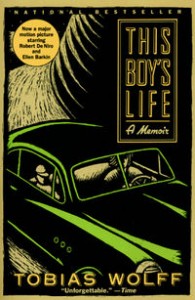
01_This_Boy's_Life_(Book)I tackled reading Tobias Wolff’s This Boy’s Life with a different gusto then I did with Andrew Pham’s Catfish and Mandela.  Paying attention to Wolff’s writing techniques and styles, I trusted my green highlighter to illuminate his writing prowess.  So after finish reading the book, I started to review the highlighted passages and realized I only had a couple.  How could this be?  I started to become frustrated that I had not paid more attention to what I was reading.  I was mentally kicking myself when it dawned on me: Wolff is such a brilliant writer that he got me to detour from my objectives and just pay attention to only his story.  So the question remains, how did he accomplish this?

In answering this question, I asked myself two questions: What is the thing and what is the other thing?  The thing is a coming of age memoir about a boy struggling to find himself.  The other thing is the taxing question of identity, alienation and escapism.  After these two revelations, other questions begin to surface.  How did Wolff manage to convey the thing and the other thing in his writing?  What writing techniques did he use?  How did he manage to detour me from my academic dissection to just enjoying the book?

Most notably, Wolff’s writing is simple but wittily composed.  In fact, there are no major dramatic plot twists or scenes in the book.  There are no far-fetched, grandiose similes or metaphors delving into the existential realms of identity, alienation and escapism.  Instead he uses a direct approach with uncomplicated, clever prose to recount his childhood.  He manages to make the memoir read like a novel.  Even though the time frame starts in the 1950’s, the narrative voice is young and contemporary.  This is important because it makes the reader feel like they are directly inside his character’s mind.  If the voice had been passive and reflective, in other words, older, then the tone of this book would have dramatically changed.  The times he changes to a more contemplative voice, the tone suddenly becomes more remorseful and regretful. (p. 27 and 121).

He establishes a youthful tone by referencing popular trends associated with adolescence.  As a child, Wolff’s character is preoccupied with guns and warfare.  Most young boys share the same fascination.  Wolff makes sure to emphasize that his first gun is his mother boyfriend’s, Roy, childhood gun, a Winchester .22 rifle, Roy had carried it when he was a boy and it was still as good as new.  (p.23)  Then the manner in which he builds a fortress and targets passersby that come within his sniper range all conjure images of a young boy playing soldier.  (p.24-26)  Even as Wolff transitions from pubescence to adolescence, he still reminds the reader that his character is still young by referencing The Mickey Mouse Club.  When Wolff and his friends watched the show, they lost their pretend grown-up demeanors and reverted back to being kids, We surrendered.  We joined the club.  Taylor forgot himself and sucked his thumb, and Silver and I let him get away with it. (p.44)  Then as a teenager, Wolff details his character’s youth by describing his inexperience, “when they discovered that I’d never been drunk and still had my cherry. ” (p. 184) By simply showcasing youthful anecdotes, the tone of the book stays young and contemporary.  I felt as though I was living out the same experiences alongside Wolff.  This made the reading light and palpable.

One technique that I noticed Wolff used to change his direct voice to a more passive voice is his use of quotation marks.  For example, he has a section where he and Roy discuss the possibility of a little brother.  Wolff uses quotations at the beginning and the end of the dialogue but noticeably absent in the middle. (p. 29)  He does this again in a conversation with his mother after their first visit with Dwight. (p. 67)  Although very subtle, it made me wonder why he would choose to employ this technique and what purpose it served.  By omitting the quotation marks, I believe Wolff wanted the reader to understand how removed he was from the conversation.  The reader feels how distant Wolff felt at that moment.  Wolff wanted to convey insincerity in his response, the same way we answer a question just to appease the person asking the question.  And in these paragraphs, Wolff does just that.  This technique is very clever and in my opinion, draws the reader deeper into the character’s thought process.  Just by removing the quotation marks in the middle of the conversation, Wolff is able to convey a mood without breaking the rhythm or pace.  The conversation continues but the reader can now visualize subtle inflections in the voice.

The most impressive aspect of Wolff’s writing is his consistent emphasis on his struggle to find his identity and his desperate need to escape, physically and mentally, the world around him.  As I mentioned earlier, Wolff doesn’t use any convoluted, complex metaphors to describe this struggle.  It’s straightforward and honest.  So honest, in fact, Wolff tells the reader on several occasions he is a liar and a thief. (p.62,133)  Wolff skillfully supplements these declarations with poignant examples throughout the book.  He layers these examples one after another so the reader has no doubt to the central struggle of the book.  Every story relates to the other thing.  He doesn’t digress.  His writing is focused and centered.

The main prevailing thought I am left with after reading Wolff’s book is that good writing doesn’t have to be complicated and convoluted.  Good writing is beautiful constructed sentences simply organized to give the reader a clear view of the message the writer is trying to convey.

Share

The Liar’s Club

13775438

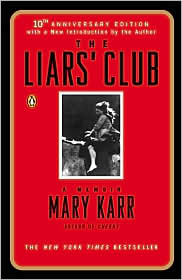
Mary Karr’s The Liars’ Club is easily the best memoir I have read thus far.  Initially, I thought her style read very similar to Tobias Wolfe’s This Boy’s Life and then come to find out ,Wolfe helped her edit the book.  Regardless, Karr carved out her own style and truly original voice in this book.  I approached this book different from the other books I have read.  Instead of highlighting and dog-earring excerpts that exhibited brilliant examples of writing (if I did that here, the book would have been painted bright yellow and filled with folded pages galore), I decided to read the book without interruption and let the impact of Karr’s writing dictate my critical response.  What impression did the story leave?  How did Karr’s writing make me thirst for more? Why couldn’t I put this book down once I started to read it?  I believe the key to the success of this book is Karr’s writing is less like writing than it is conversational.  I feel like she is telling the story rather then remembering it.  There is no judgment or moral implication nor does Karr strive for any.  It’s straightforward and un-complicated.  The language is tremendously simple yet ingenious.

Karr is also a published poet and her poetic style is evident in her writing.  Unlike Larry Woiwode’s What I Think I Did: A Season of Survival in Two Acts (whose book I thought was brilliant), her style of writing is more fluid and informal.  I especially love her use of parenthesis to inject her insight or clarification in the middle of a paragraph.  This technique made me feel as if she was whispering a secret.  It established a wonderful intimacy and made me trust her.  Using the parenthesis allowed her to warp time and add relevant information from the past, the present or the future.  She managed to weave different stories together without making the reader feel dizzy or lost.  She could be talking about her mother and then jump to her father’s reaction and then springboard to her sister’s response without losing continuity.   Her success was the fact that all the stories were related and helped support Karr’s main idea.  The main story was like a trunk of a tree and the side stories were like the branches.  It all connected together seamlessly.  Karr’s approach was systematic.  She would write about her memory of an event and then supplemented that memory with different family member’s reaction.

I think the times when I enjoyed the book the most were when she would write about her sister’s reactions to her follies and fumbles.  She could have easily just wrote about the events and described it in her own voice but instead she cleverly chose to allow her sister’s, Lecia, comments to describe the lightheartedness or seriousness of the subject.  There were several times where Karr would write – If Lecia was writing this or Lecia states – that I found myself relishing these tidbits of outsider knowledge because it peppered what Karr was writing.

Karr wr0te the book mainly through the perspective of a younger Karr.  She later fast-forwarded the perspective to an older self towards the end of the book when she dealt with her father’s death.  Karr’s younger self is a strong character in the book.  This book is definitely character driven, even though there were many events that take center stage.   She carries her child perspective even when she writes about being molested as an eight year old.  This was probably the most powerful story in the book.  I literally almost skipped this part because the way she describes the molestation put me in the reference of a small child.  It was almost more than I could bear.  Her honesty and objectivity of this story was truly astounding.  She didn’t break away from her character and didn’t add any social commentary.  She wrote about it in the same way she wrote about horseback riding or shooting a gun.  And that’s what made this story that much more powerful. Karr’s succinct and direct approach is truly inspirational.  There was no hint of remorse or condemnation one would expect in her story telling.  The reader is left with the magnitude of the situation without any forceful diatribe from Karr.  I was left speechless and in awe.

For the longest time, I looked at David Sedaris’ writings as a model for how I would like to write but after reading this book, I have found a new inspiration.  Her similes and analogies made me say wow and that was great out loud so many times I sounded like a broken record.  Reading Karr’s writing, I understand the powerful impact of well thought-out images or similes.  Consistency with an image is crucial.  I know that Karr’s experience as a poet helped her writing, but the fact that she knew when to reign in superfluous analogies, I believe is her strength.  She wrote in simple terms but cleverly constructed so that the reader wasn’t jumping from a simple image to an ornate one.  She wrote every detail with crisp everyday language.  And to spice things up, she would insert local colloquialism that added humor and originality to the story.

Share