Leave the Chinese Out of Chinese New Year

Lunar New Year 2014Happy New Year!

Yes, I’m wishing you a happy New Year way past January 1st.  This is the time of the year where millions of people are celebrating the Year of the Horse. Families have cleaned and decorated their homes from top to bottom, altars have been constructed, special New Year’s meals have been cooked and consumed.  Everybody is doing whatever they can to ward away evil spirits.  Traditions run deep during these celebrations.  But there is one tradition I want you to break…please take “Chinese” out of Chinese New Year.

Just because over a billion Chinese citizens celebrate the Lunar New Year doesn’t make it exclusively their own.  That’s right, it’s not Chinese New Year, it’s the Lunar New Year. On the same day, Vietnamese people celebrate Tet and Koreans celebrate Seo naal.

So what’s the big deal you might ask?  Who cares if it’s called Chinese New Year? Well, I do.

By calling it Chinese New Year, it once again reinforces the ideology that Asians fall into two categories:  Chinese or something else.  Inherent in this ideology is that being Chinese is superior and not being Chinese…well, just sucks.

All my life, the first question people ask me concerning my ethnicity is, “Are you Chinese?”  No offense to my Chinese friends and associates, but the question provokes an intense reaction.  So when well-intentioned people wish me a Happy Chinese New Year, I have to control the urge to not throw a full-on-yelling-pull-my-hair-thrashing-on-the-floor tantrum.  Yes China has the lion’s share of Asians in the world, but that doesn’t mean they get dibs on making the Lunar New Year exclusively theirs. They can have Chinese lanterns, Chinese horoscopes and even Chinese buffets…but I say hands off the New Year.

Also, since when does a New Year have to be ethnically descriptive?  When was the last time you heard someone wish another person Happy Caucasian or African-American New Year?  When Jews celebrate the New Year, you’ll never hear them say, Happy Jew Year.  People simply wish each other a Happy New Year and so the same courtesy should be extended to those who celebrate the Lunar New Year.  Trust me, even Chinese people while wishing each other Happy New Year leave out the “Chinese” part. It’s time the rest of the world should too.

I know that change can come. I am impressed that nowadays more and more people are accepting and acknowledging different cultures and traditions. For example, more people know about Vietnamese pho and banh mi then I ever thought possible.  Not long ago, Sirracha hot sauce was a condiment only found in Asian restaurants and households, but now I find the iconic bottle in Target and grocery stores.  Perspective and attitudes can change.  So when the Lunar New Year comes around again, don’t wish people a Happy Chinese New Year, even if they are Chinese. Just wish everyone a Happy New Year like you would do on January 1st.  Non-Chinese folks like myself will not only appreciate the sentiment…we’ll also appreciate the inclusion.

 

Share

South Florida Asian – A Rare Breed

If I were to write a personal ad, it would go something like this: short male, black hair, brown eyes, caramel-colored skin…then I would probably go on at length about my sculpted body and model looks…ok so that’s more wishful thinking than anything.  If you came across my profile, you wouldn’t hesitate to think Latin male right?  The dark features and tan skin are dead giveaways.  But what if I added slightly oval eyes, like large almonds, what would you think then? Asian?  In South Florida?  No way…there are no Asians in South Florida.  Perhaps not many, but there are.

Yes I’m Asian, more specifically Vietnamese.  I moved to South Florida after finishing college in New Orleans.  In New Orleans, you couldn’t walk a couple of feet and not bump into another Asian.  Not the case down here.  Every once in awhile I would spy another Asian and then a slightly awkward exchange occurs.  First there’s that moment of disbelief.   Did I just see another Asian?  Or was it a mirage, like when you’re driving and you swear the road looks wet.  After a couple of double takes confirming that they are indeed Asian, a serious stare down ensues.  A silent game of guessing their nationality commences. Side note here…for those who say they can distinguish the different Asian nationalities…you can’t.  I get mistaken for Filipino all the time.  After the stare down, a couple of things can happen…both parties do nothing or they give simple nods acknowledging each other’s presence or a pretense to finding a spec of dirt on the floor interesting so one party can move in closer.  If greetings are shared, the indubitable questions are asked: where are you from, how long have you been here, you know there aren’t a lot of Asians in South Florida, etc.

Living in South Florida, Asians are definitely a minority.  You would think the tropical weather would be a magnet for Asians, but for some reason, the azure beaches aren’t much of a draw.  Due to proximity, Latin and Caribbean cultures dominate.  I took French in school, but much good that does me down here.  I quickly learned to ditch “bonjour” for “hola.” In no time, saying “mira” and “ay dios mios” required little effort.  And the one thing I’ve learned living in South Florida is people are divided into two categories…Latin or Not Latin. And if you have the slightest resemblance of being Latin, you’re presumed to be so.  People approach me all the time speaking Spanish at full throttle.  There’s no point in saying, “Yo no habla espagnol” because the response I receive is, “Si, tu habla espagnol!”

One line does not a fluent Spanish speaker make.

So what I usually do nowadays is point to my eyes, the obvious sign that I’m Asian.  Sometimes that’s enough to convey I’m not a Spanish speaker, but more often than not, the person looks up and continues to hurl Spanish words at me.  Confusion sinks in.  Should I be offended that they’ve ignored my Asian identity or impressed that they are so willing to accept me into their culture?  No Salsa or Meringue auditions, no flan making test…who knew that the mere utterance of  “que tal” is the Spanish equivalent of “open sesame.”

As an immigrant myself, I find that I have more in common with my Latin and Caribbean neighbors than I ever thought possible.  The chorus of the immigrant song is a familiar tune no matter where you are from.  Some immigrants have escaped oppressive regimes.  Others, who at any costs, risked their lives to ensure brighter futures for their families.  It’s why I understand the push for the Dream Act.  When mothers recount their struggles to get their children to the US, I see my own mother.  Fathers are channeling my own when they talk about overcoming insurmountable obstacles.  I see Haitian refugees on rafts and it reminds me of the throngs of Vietnamese refugees escaping after the war.  What if my family were turned away?  Where would I be today?  Even though, I still find it hard to add “American” after “Vietnamese” when describing myself, I’m grateful that I have the option.  Many would gladly change places with me.

So I have chosen to live in South Florida where the nearest Chinatown is over 1,000 miles away and perhaps, I don’t see people that look like me very often, but you know what…I’m ok with that.

Latin spices, Caribbean flavors, beautiful beaches…in retrospect I think I’ve gained more than I’ve lost.


This article was published by WLRN.  The link is here:

http://wlrn.org/post/being-asian-south-florida-means-disbelief-stares-and-latin-confusion


Share

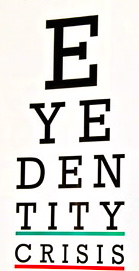
Mistaken Eye-dentity

This time, it happened as I was exiting my car and walking towards an office building for a meeting.

“How many trucks do you have, Leonard?,” this 40-ish looking man, standing in front of the office doors, shouted at me enthusiastically.

I didn’t recognize him.  I turned around to see if he was talking to someone behind me.  No one.  When I approached the doors, he ovaled his arms to give me a hug, but when I stepped back, he stopped short, his hands suspended in the air like he was dancing with an invisible partner.

“Oh I’m sorry,” he said.  His hands deflated to his sides.  “You looked like an Asian guy I know.”

The time before this, I was changing in the locker room, when a man came up to me and buddy punched me.

“Hey man, long time no see!”

“I’m sorry, but I think you got the wrong guy.”

“No way, you don’t remember me?  I’m your massage therapist.”

“I’m sorry, but I think you got the wrong guy.”

“No way man.  I remember you.  You need to book another appointment!”

His insistence made me wonder, for a slight second, if he indeed was my massage therapist, but I knew I never met the man.

“I’m sorry, but I think you got the wrong guy.”

“You’re sure it wasn’t you?  It was an Asian guy,” he told me assuredly, almost as if I needed reminding.  I finished dressing and walked out.

Millions of Asians worldwide and I just happen to look like every one of them.  People see my eyes, my hair, my skin color and instantly I’m the Asian they’ve seen on TV, the Asian they work with or the Asian they went to school with.  I never knew I had the universal Asian face.  This must be the reason why I’m the subject of so many cases of mistaken eye-dentity.  Because if it wasn’t for my eyes, how would they link me to an entire race?

Recently, I was at my company’s Christmas dinner and while I was sitting at the table, one of my co-workers mistook me for Bohn, the other Asian in the office.

“Hey Bohn,” she said to me.

Everybody at the table looked at her, then at me.  No one corrected her.  Perhaps she just confused our names, but then she continued.

“Bohn, who’s that guy sitting next to Mary Ann?”

The guy she was referring to was actually Bohn’s co-worker.

“That’s Sean,” I said.  “He works with Bohn.”

She glared at me.  The confusion switch flipped on.  At first, I wasn’t sure if she thought I was the type of person who referred to myself in the third person.

When Bohn talks, Bohn likes to address himself as Bohn.

But then it dawned on her, that perhaps I wasn’t Bohn.

Bohn and I are roughly the same height, but that’s where the similarity ends.  His hair is almost shaven, while mine is spiky with a punk silhouette.  His skin tone is darker.  He’s more rotund.  He’s Cambodian.

In my opinion, we look nothing alike, but the fact that we are both Asians made us indistinguishable.  When I left the table, still unconvinced, my confused co-worker turned to the table and asked, “That’s not Bohn?”

I know people have cases of mistaken identities all the time, but the frequency of it happening to me is quite high.  Is this just an Asian phenomenon?  After all, Asians have amassed a worldwide population of almost four billion.  I’m bound to remind someone of an Asian they know.  But the curious fact is that not one Asian has confused me for another.  Do Asians see the differences that are obvious to us, but are subtle, if not invisible, to non-Asians?  Perhaps it’s the same way specialists discern stripe or spot patterns in tigers and leopards.

When other co-workers approached me a couple of days after the Christmas party, they were still tee-heeing about the incident.  “At least she got the Asian part right,” I told them.  If she had confused me with Sheldon, my black co-worker, then perhaps then I might be slightly worried.

Worried not for me, but for Sheldon.

After all, can he handle being the poster boy for the Asian community?


Share

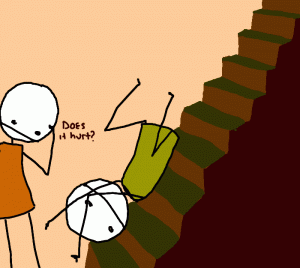
You’ve fallen and I can’t stop laughing

fallingI have an admission.

It’s not something I am proud of but, as the old adage goes, the first step in solving a problem is to admit you have one.

So here it is. I laugh when people fall.

I don’t mean a slight snicker but a jackknifing so hard, I get whiplash.  Someone could trip from a bump in the sidewalk and I will laugh so violently, my convulsions could be mistaken as seizures.  I don’t know why I find falling, tripping, sliding, face planting and bum crashing down right hilarious.  Actually, I don’t limit my outbreaks to the lower extremities, anyone stubbing their fingers, bumping their funny bones, going face forward into a glass door all get the same reaction: me holding my sides, tears streaming down my face, yukking so loudly, people stop what they’re doing and stare.  And if you think I only laugh at people, think again, animals are definitely fair game.

Now before you think I am this heartless, insensitive creature, I do want to clarify.  I do have the ability to discern the difference between fainting, collapsing or tumbling due to medical emergencies and I do act appropriately.  However, all bets are off if the person revives and manages to walk away, albeit limping.  Then, and only then, in my opinion, is it OK to laugh.

Once, when I was at dinner in a quasi-formal restaurant with a bunch of friends, we got on the subject of tattoos.  There were some debate about who had one, who wanted one and who wouldn’t be caught in hell with one.  The conversation steered towards the pain and the needles involved.  One of my friends, a State Trooper, mentioned casually he doesn’t like needles or anything blood related, in fact, the mere mentioning of either topic causes him to feel queasy.  With three to four years of Trooper experience, he’s a tall guy, at least 6’3, probably around 200 pounds, teetering on the slippery edge of being thirty, not overly muscular, but no couch potato either.   Sitting at the end of the table, he pleaded softly for us to change the topic.  Not taking him seriously, I carried on how the needles really didn’t hurt, how it felt like someone pressing the bristles of a hairbrush against my skin and that’s when it happened.  My friend’s eyes rolled back into his head like stuck numbers on a slot machine.  Before we could grab him, he fell face forward, intimately going to first base with the shag carpet.  His face dug deep in the carpet while his body teepeed up with his rear end flashing us.  Imagine a giant upside down V.  Of course, we all jumped up and ran to his side, flipped him over and began slapping his face.  His eyelids fluttered like the quick beats of a moth’s wings.  As he came to, he muttered incoherently, “What happened? Where am I?”  “On the floor,” I said, “You passed out”.  With the help of some cold water, he regained consciousness.  We quickly paid the bill, pulled the car around and carried him out.  Afterwards, he had a huge strawberry that skunk tailed down the front of his face.  He told his co-workers he got smacked with a branch while working in the yard.

The whole time I was in stitches.  First, the image of him – a State Trooper, face smooching carpet, ass up in the air – was hysterical.  Second, him lying supine in the middle of the restaurant, diners huddled over, managers frantically wanting to call 911 was something out of a comedy.  Third, because of his size, everything was exaggerated – the dramatic fall, the awkward positioning, the hunched over rescue.  Afterwards, each time I saw him, I would imitate a redwood tree falling.  Knee slapping, eyes watering, I would guffaw like a barking seal when I was done.  He didn’t find it very amusing, nor did my other friends.  You are evil, they told me.

When I went back home to Vietnam, my reserved cousins were absolutely shocked at my brazen laughter.  When one almost tumbled into the creek, I was doubled over in hysterics.  When she straightened herself out, she looked at me and said, “How can you life at the misery of others?”  Hmmm, easily I thought.

But I’ve gotten better.  I have controlled my fits of laughter so that I don’t bust a gut immediately.  For instance, a couple of months ago, I was washing my hands in the bathroom, when a man, using the urinal, lost his pants.  I don’t mean lost as in he couldn’t locate them, but lost as in the middle of relieving himself, his pants plunged to the floor.  I couldn’t see the reaction on his face nor could he see mine since he was facing the wall.  For that, I was grateful because I was desperately trying to suppress my reaction.  Another man came in, stopped and did a double take when he saw the underwear-clad man.  He saw me and tilted his head towards the semi-naked man, I shrugged, feigning ignorance.  I left as the man bent down to lift his pants back up.  I barely contained my laughter as I walked out.

I think Miss Manners would probably advise us to ignore these situations and pretend they didn’t happen, but that’s easier said then done.  Don’t get me wrong, I don’t exclude myself when I fall or trip.  If I take a tumble, I’m the first one hunched over laughing afterwards.  It’s funny.  It’s the reason why videos of people nose diving or ass cracking are the most watched videos on the Internet.  C’mon admit it, you chucked a little, if not a lot, when you imagined my friend with his face buried in the carpet and ass to the ceiling.  It’s ok if you did, he’ll never know and trust me, I won’t tell.  We’ll just make it our little secret.

Share

The Gangster We are All Looking For

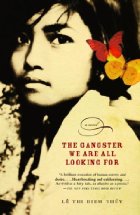
0375700021.01._SX140_SY225_SCLZZZZZZZ_Le thi diem thuy’s (according to her, she likes her name in lower case) The Gangster We Are All Looking For is not so much a biography but a collection of vivid poems beaded together to form a succulent narrative.  Although the book is a work of fiction, she borrows events from her real life (her assimilation to American life and the deaths of her brother and sister) to weave a powerful and moving tale of overcoming adversity and sorrow.
le’s background as a playwright is evident in this novel as she crafts tremendous scenes portraying the hardships her family endured.  Using simple but eloquent sentences, the majority of her paragraphs are no more than five or six sentences long.  Like clipping along a fast current, this style enhances the back and forth time and location shifts as she writes about her life in Vietnam as well as her life in America.  She prefers to paint the scenes with dramatic imagery rather than deliver a straightforward approach,

He would gaze beyond a person’s shoulder as though watching storm clouds gather on the horizon. Neither holding the clouds back nor inviting them on, his eyes merely took in their approach. More than once I have seen people talking with him turn around to see what was behind them.

As a Vietnamese writer, I understand and relish what some may describe as an over-dramatic style of writing.  The Vietnamese language is inherently flowery so when writes this Vietnamese English, I appreciate its complexity as well as its simplicity.  For example, she doesn’t just write about war, she allows the reader to partake, to suffer and more importantly, to imagine what war was like for her as well as her family.

Ma says war is a bird with a broken wing flying over the countryside, trailing blood and burying crops in sorrow. If something grows in spite of this, it is both a curse and a miracle.  When I was born, she cried to know that it was war I was breathing in, and she could never shake it out of me.

A good writer knows when you can show more then tell: show.  And does this wonderfully.

Even though the theme of the book is centered around tragedy, the book doesn’t bog you down in pity or deep reflection.  Structurally, it reads more like a fairy tale and an adventure novel.  By telling the story in brief, fragmented spurts, it keeps the reader’s attention and builds tension along the way.  As each scene unfolds, I found myself quickly turning the pages.  Her words, like morsels of good food, made me want to consume more.

Share

Other Is Never a Good Category

OtherOtherFront_001In middle school, my teacher, every once in awhile, asked all the white students to stand, followed by all the black students and then she tallied the results.  At the time, there were only two Asians in the class: a Vietnamese girl and me.  We both looked at each other, not knowing if we should speak up.  This purgatory confused us: we didn’t know what group we belonged in.  We were more white than black, so did that mean we should be included with the white students?  Then again, the black students were considered minorities, so it was probably more appropriate for us to join their group.  To make matters even worse, the teacher neglected to even include us, which made our status even more ubiquitous.

It turned out, the teacher was conducting a survey of the ethnic makeup of the class.  She saw the class as black and white, with no shades in between.

When we did speak up, she looked at us, her eyebrows cocked unevenly as she wondered how to categorize us.  She wondered out loud what box she should place us in.  She took some time and decided to include us with the white kids.  The first time we didn’t argue.  However, the second time she conducted the count, I decided to take a stand.

“I’m not white,” I said, “Nor am I black.”

She stuck her pencil in her mouth and began to chew on the eraser.  My words, like water dripping from a crack, seeped in her mind.

“Don’t you consider yourself white?” she asked.

I shook my head no but secretly I had been.  My friends were white and everything I’ve come to associate with America thus far had been through the perspective of a white American.  But for some reason, this time I wasn’t content to being lumped together with a group of people that was completely different from me.  Something was nagging me to be more authentic.

“What do you consider yourself as?” my teacher demanded.

“Vietnamese,” I replied.

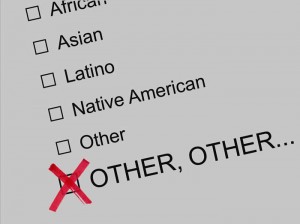
“There is no category for Vietnamese.  I will just have to make another category and label it as other.”

Other, the catchall category that combines together every ethnicity other than black and white.  It’s the closet you hide all your junk in when you want to do a fast clean up.  I hated the word other.  It always connoted something that wasn’t a first choice: the other women, the other friend, the other child.   I didn’t want to be other.

“Can’t you write Vietnamese instead of other?” I asked.

She looked at me, her lips pursing as if she just licked an invisible lemon.

“No, I can’t because then I would have to write something different for everyone.  It’s easier to just write other.”  She said this congenially like a parent convincing a child to eat his vegetables.

“It’s not that important anyways,” she added.

At the time, I was hard press to argue otherwise.  Being Vietnamese was the least of my priorities.  If a friend had a plastic Superman watch, I wanted one.  If one had a GI Joe lunch box, I wanted one.  I was taking my cues on how to be an American from them.  I tried to dress like them – I even wore cowboy boots with shorts because a friend did so, much to the ridicule of my siblings.  I tried to get my parents to buy a set of Encyclopedia Britanica because after all, according to the brochure, almost every American family had a set.  I tried to match our thrift store bed linens together, so that our beds would look like the model beds showcased in houses christened the American Dream by television commercials.

But my family showed no interest – they cared less about encyclopedias and were happy with the mismatched sheets and pillowcases.  It was hard for me to be an American in a Vietnamese family.

It didn’t help that my mother planted her rau muong or water spinach in the ditch in front of our house.  Similar to the texture of spinach, rau muong is a popular staple in Vietnam.  It only needs a steady supply of water for it to grow so when my mother saw the ditch, she knew it was a perfect place to plant it.  In no time, my mother had a nice crop of rau muong sprouting in front of our house.  When she wanted some, she headed out to the ditch and snip the stalks with scissors leaving the roots behind.  Freshly clipped, the tips of the roots poked out of the ground liked newly transplanted hair plugs.  When my friends came over, I never mentioned the garden.  To the untrained eye, the plants looked liked over-run weeds.  My mother usually picked the plants in the evening before dinner, so I didn’t have to worry about my friends ever seeing her, but once she decided to pick the plants a little earlier and as chance may have it, my friends and I happened to walk by.  They saw my mother in the ditch, squatting on her haunches toad-like, snipping away.  All she needed was a conical hat and you could imagine her planting rice in the waterlogged fields of Vietnam.

“What is your mother doing?” one friend asked.

“Nothing,” I quickly replied.

“Does your family eat grass?” another questioned.

“No, we don’t eat grass,” I replied angrily.

“It looks like grass to me,” the friend said.

The rest nodded in agreement.  That’s how it came to be that my family ate grass.  A running joke that surfaced when any of my friends cut their lawns, how they would save the clippings for us.  If I had been savvier, I could have retorted with a clever comeback. My mother was using the exotic miniature leaves as garnish or in a wedding bouquet or that she was a horticulturalist conducting research. But I wasn’t very clever, so I endured the ribbing.

After much pleading, my mother later moved the garden to the backyard.  I figured if I couldn’t uproot my past, I could uproot the garden. The garden didn’t last and the plants died.  She never grew rau muong again. From then on only cooked what she bought at the store.  My mother never expressed her disappointment in the garden or in me.

Share

What’s in a Name?

images

I remember a poignant scene from the movie What’s Love Got to Do With It? where Tina Turner is divorcing Ike Turner and she’s willing to give up everything as long as she gets to keep her name.  All I want is my name, she said proudly.  Her name meant more to her than all her riches or her royalties.  I sat there watching this scene thinking would I do that?  Would I give up everything for my name?

Recently, I had dinner with a friend who has his family crest tattooed on his forearm.  His family name proudly scripted in large letters above the shield.  Inked in a visible place, his crest demands attention.  He tells me if his older brother didn’t have a son, the family name, the one emblazoned on his skin, would be lost.  It’s up to the son to pass on the name.  Such pressure on this child, I thought.  The burden of a family lineage resting on his shoulders.  What if he turns out like me?  Someone who is willing to change his name to assimilate and blend in.  If I have to attend an event where I have to wear a name tag, I spell my name Lee minus my last name.  I am transformed into a one-word name like Elvis or Sting. The transition to becoming Lee, an American who grew up in the south, who graduated with a Biology degree, who enjoys living by the beach, is easy.  It’s more difficult to be Ly, an immigrant from Vietnam who struggled to  learn English, who rounded his eyes in the mirror, who tried to change his name.

I think about my mother whose maiden name I didn’t learn until I had to use it while filling out paperwork for my first loan.  When she got married, her name dissolved, like sugar in hot tea, into my father’s.  For nearly fifty years, no one  called her by her first name.  Even her own mother opted to call her ma lan or mother.  Many years later, when she left my father to live with me, I was caught off-guard when my neighbors greeted my mother by her first name.  I’ll admit that I was surprised, if not a little angry, when she acknowledged her name.  In my mind, that name didn’t exist except only on paper.  I realized, all those years, I never connected my mother to her name, never saw her as an individual, a separate entity apart from my father or my family.  When my neighbors said her name out loud, I stopped in mid-step, my auditory senses triggering my visual ones and an independent woman appeared, someone completely different from the woman who raised me.  Her name, one I didn’t even think she would even recognize, suddenly took form.  What dawned on me was that there was no way my neighbors could have known her name unless she told them.  They must have asked her what her name was and she must have replied, Gam, pronounced like gum but with an accent.

My name is Gam, I imagined her saying in her staccato English.  It’s almost inconceivable that she could ever express such words.  But she had to and by the looks of her exuberant behavior, it was something she has wanted to do for a long time.  Reclaiming her name, after so many years of denying or hiding it, has brought about an unbelievable change, imagine Lynda Carter spinning as she transforms into Wonder Woman, only not as fast.  The pride she feels in her name is infectious.  Well, almost.  Can I say I have the same amount of pride newly discovered by my mother?  I can honestly say I don’t know.  I have accepted my name and have grown to appreciate its uniqueness but I still don’t correct people when they spell my name Lee.  I let them discover the correct spelling on their own.  The reaction is always the same, Oh, I didn’t know you spell your name L-Y. I would smile, not offering much of a defense.  Perhaps I have to lose it, like my mother did, to know the value of it.  Then maybe and that’s a big maybe, I would even have the courage to tattoo it on my arm. ip address

Share

Life and Death: The Vietnamese Way

260xStory

Asians, especially Vietnamese, are very peculiar about the notions and perspectives surrounding death.  For example, I was shocked to discover that Americans and perhaps, most citizens of the Western world do not photograph funerals or wakes.  It never occurred to me that this might be considered odd or at the very least, morbid until a friend was completely shocked when I showed him pictures of my grandmother’s funeral.

Why would you take pictures at a funeral? he asked, shaking his head in disbelief.

Why would you not? I indignantly retorted back.

I’ll have to admit, weddings, funerals or any large get-togethers give my family an opportunity to use our cameras.  Constant picture taking has strengthened our index finger to the point that it is second nature for us to press down on any shiny metallic button.  In fact, our picture-taking reflex is almost autonomical like blinking or breathing.

Growing up, my family used to receive pictures from funeral services of relatives in Vietnam.  The pictures were usually the same: black and white photos of relatives standing over graves or caskets looking grim and sullen.  On occasion, the accompanied letter would sometimes describe grief stricken family members trying to crawl in the casket of the deceased.  Whenever we got those letters, it would always spark a debate among the children as who in the family would be the casket crawler. Somehow I was always chosen being that I have a flair for the dramatics.

When my family got these funeral photos, we didn’t flinch or wince.  To us, morosely, it was like receiving a postcard but instead of saying, Wish you were here, ours would say, Wish your uncle was alive or Wish your cousin was here to enjoy this.

Vietnam is not only physically on the opposite side of the world from America, it’s also its philosophical opposite.  Most funeral services in America consist of mourners wearing black attire.  Men dressed in black suits and dark ties, women in black dresses and the occasional black veil.  Traditional Vietnamese funerals are contrastingly different.  If you ever walked in on one, you would probably stop dead in your tracks (no pun intended).

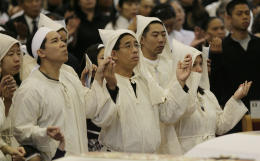
The most striking contrast is that Vietnamese mourners do not wear black: we wear white.  Well, I should clarify: the immediate family of the deceased wears white.  While Americans traditionally view white with weddings, Vietnamese associate white with funerals.  Red is the color of choice for weddings as it represents prosperity and luck, while white represents loss and a passing of life.  The color white symbolically represents the ashes of the deceased.  Since most Asians are cremated, it’s more appropriate for funerals than black.

When you attend a Vietnamese funeral, you’ll notice the deceased’s immediate family is sitting or kneeling in close proximity to the casket.  However, it is not the close distance that immediately draws your eyes but the traditional mourning regalia: white robes, pants and pointed hoods.

The outfit consists of white pants that billow out like over-sized pajama pants, a white wrap-around tunic that makes anybody who wears it a Samurai double and last, but not least, a white, pointed hood.  The hood is simple in design, two pieces of white cloth sewn together to form a pointed end, long enough to cover the neck but exposed in the front to show the mourner’s face.

Unfortunately, when I mention white, pointed hoods, it conjures images of the Klu Klux Klan.  However, the biggest difference is that Vietnamese are not ashamed to show our faces. Amazing how iconic a white hood is in American society that it immediately evokes feelings of hatred and animosity.  Asians view a white hood as sorrow and loss.  I guess, by the same token, Americans probably feel the same.

To Americans, talking about death is taboo but to my family, it’s connecting a duality.  Death is just as much a part of life as is the reverse, a delicate interwoven tapestry.  There is a balance as fine as a silk thread that has long been revered by us.  When we take pictures of funerals or wakes, it’s not to be macabre but more like a quiet reverence.  The pictures show the deceased was just as important in death as when they were alive.  When we are older and our memories begin to fail, we are comforted knowing that we have our pictures to show us the full panoramic view of our loved one’s life.

Share

Mother

b2

no fax payday loans online

My mother has come down to visit me for a couple of months to escape the frigid cold of Tennessee.  Her constant complaining to my brothers and sisters has done the trick.  It started with her being too cold.

It’s too cold here.  I’m so cold, my old soul is frozen, she proclaimed.

Lost in translation, it’s much more dramatic in Vietnamese.  My brothers and sisters nipped that complaint by buying her enough clothes to make an Eskimo sweat.

When that failed to produce a first class ticket to Florida, she pulled out another card from her deck of emotional manipulation: Nostalgia.  Not just regular nostalgia, but Asian Homeland Nostalgia.

Remember when we were in Vietnam and used to go the beach.  Remember how much fun we had.

Then came the obligatory sigh and slumping of the shoulders.

Growing up in Vietnam, your grandfather would take me to the beach.  Florida has beaches like Vietnam.

In response, my family gave her prints of the beaches in Vietnam and a picture of my grandfather.

Frustrated, she pulled out her trump card: Asian Mother Guilt.

Asian mothers have the ability to change kernels of guilt into full-blown stalks of blame and penitence.  When Asian mothers are in this mode, it’s best to lay supine on the floor and act dead.  Hold your breath for as long as you can and stay still because if she detects you survived the initial blow of guilt, she will go after the jugular.

You were a difficult birth.  Your father was away and I had to walk to the hospital…bleeding. I was too far along and had to deliver you right away without anesthesia.

I breastfed you until you were six.

I piggybacked you to school while you screamed in my ear.

I cleaned toilets and scrubbed floors so you could go to college.

And then the clincher…

I’m so glad I did all that.  If I should die tomorrow then at least you will generic viagra usa know that I loved you and that there isn’t anything I wouldn’t do for you.

It’s enough that these words cut your heart in half but the wailing and the streams of tears make for a complete soap opera.  So now she is here with me in Fort Lauderdale.  Her broad smile stretches across her face when the warm Atlantic breeze tousles her charcoal black hair.  She seems happy but this happiness is as short lived as a compliment from your boss.  This is my mother after-all.

Share

Agony of Defeat

sorrow

This is where it happened.

legitimate payday loan consolidation

What happened, I asked?  Did something bad happen?

Yes. Somebody died here.

Who died?  Who got killed?

With deep hesitation, she looked at us and said, Your grandfather.

My brother and I stared at her in disbelief.

?  Our word for mother in Vietnamese.

This is where the loving man I knew as a child died and, here in his place, a sad, remorseful man was born. This is where the Viet Cong had your grandfather brutally beaten.

During the war, the Viet Cong illustrated their might by having respected members of the community publicly beaten.  As if the beatings were not humiliating enough, the Viet Cong forced neighbors to carry out these beatings.  With the bravado of militant gang members, they effectively demoralized the village leaders.  Once the leaders were subdued, they knew the people would be easier to control.

In the early 1950’s, the Viet Cong began to dominate the northern provinces.  They particularly targeted small local villages where the weak defenses made them easy prey.  My mother’s hometown of Thien Hien was no exception.  After squelching all resistance, the Viet Cong began to select distinguished village members to harass.  In my mother’s poor village, my family had some modest repute.  My grandfather was the son of the village’s equivalent to a mayor.  His status made him the prime target of the Viet Cong.  It was only a matter of time before they made an example out of him.

My mother remembers the day the Viet Cong invaded their home with mob-like ferocity and strong-armed my grandfather out of the house.  They forced him to kneel execution style on the sidewalk.  Then, they coerced his neighbors onto the streets.  Once outside, the neighbors solemnly encircled him like mourners at a funeral.  One by one, they were shoved in front of him.  Manipulated like marionettes, each villager was forced to slowly lift my grandfather’s chin with one hand and then quickly slapped him with the other.  His face was raised each time so he would have to stare into each neighbor’s eyes before and after each strike.  If the villagers were too lenient or soft handed in their blows, the Viet Cong made them do it again until they were satisfied with the severity.  If he fell to the ground, he was propped back up in his kowtowed position.

Powerless to stop it, my mother and the rest of the family stood on the perimeter clutching each other for comfort.  She watched in anger and disbelief at his defilement.  He didn’t cry out or lash back.  He knelt in complete silence accepting the fate delivered to him.

In the aftermath, his cheeks were dyed crimson from the many blows he endured.  His hair mangled and frayed like steel wool.  His head bent so low his chin rested on his chest.  His blackened eyes no larger then small slits.  Thick, syrupy blood oozed out of the hollows of his nose.  His swollen lips unable to hinder the cerise saliva spooling out of his mouth.  His gnarled knees bloodied from continually scraping the cement as he tried to balance himself during each blow.  His hands clinched tight ballooning the leafy veins in his arms.  Shoulders, once jauntily dignified, now stooped in relinquished defeat.

The same hands that delivered the punishing blows were now lifting him up and carrying him home.  Apologies were made but my grandfather said nothing.  Once inside, my mother cleansed and bandaged his wounds.  He didn’t breathe a word.  Staring blankly in front of him, he sat inert and leaden.  She saw the emptiness in his eyes and felt his hands quiver like viagra order no prescription a cautious flame.  She set out to console him with an embrace but he slowly turned away from her like someone trying to hide his tears.  With strenuous effort, he laid down, turned to face the wall, and closed his eyes.

Share