Mistaken Eye-dentity

This time, it happened as I was exiting my car and walking towards an office building for a meeting.

“How many trucks do you have, Leonard?,” this 40-ish looking man, standing in front of the office doors, shouted at me enthusiastically.

I didn’t recognize him.  I turned around to see if he was talking to someone behind me.  No one.  When I approached the doors, he ovaled his arms to give me a hug, but when I stepped back, he stopped short, his hands suspended in the air like he was dancing with an invisible partner.

“Oh I’m sorry,” he said.  His hands deflated to his sides.  “You looked like an Asian guy I know.”

The time before this, I was changing in the locker room, when a man came up to me and buddy punched me.

“Hey man, long time no see!”

“I’m sorry, but I think you got the wrong guy.”

“No way, you don’t remember me?  I’m your massage therapist.”

“I’m sorry, but I think you got the wrong guy.”

“No way man.  I remember you.  You need to book another appointment!”

His insistence made me wonder, for a slight second, if he indeed was my massage therapist, but I knew I never met the man.

“I’m sorry, but I think you got the wrong guy.”

“You’re sure it wasn’t you?  It was an Asian guy,” he told me assuredly, almost as if I needed reminding.  I finished dressing and walked out.

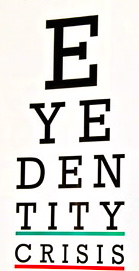
Millions of Asians worldwide and I just happen to look like every one of them.  People see my eyes, my hair, my skin color and instantly I’m the Asian they’ve seen on TV, the Asian they work with or the Asian they went to school with.  I never knew I had the universal Asian face.  This must be the reason why I’m the subject of so many cases of mistaken eye-dentity.  Because if it wasn’t for my eyes, how would they link me to an entire race?

Recently, I was at my company’s Christmas dinner and while I was sitting at the table, one of my co-workers mistook me for Bohn, the other Asian in the office.

“Hey Bohn,” she said to me.

Everybody at the table looked at her, then at me.  No one corrected her.  Perhaps she just confused our names, but then she continued.

“Bohn, who’s that guy sitting next to Mary Ann?”

The guy she was referring to was actually Bohn’s co-worker.

“That’s Sean,” I said.  “He works with Bohn.”

She glared at me.  The confusion switch flipped on.  At first, I wasn’t sure if she thought I was the type of person who referred to myself in the third person.

When Bohn talks, Bohn likes to address himself as Bohn.

But then it dawned on her, that perhaps I wasn’t Bohn.

Bohn and I are roughly the same height, but that’s where the similarity ends.  His hair is almost shaven, while mine is spiky with a punk silhouette.  His skin tone is darker.  He’s more rotund.  He’s Cambodian.

In my opinion, we look nothing alike, but the fact that we are both Asians made us indistinguishable.  When I left the table, still unconvinced, my confused co-worker turned to the table and asked, “That’s not Bohn?”

I know people have cases of mistaken identities all the time, but the frequency of it happening to me is quite high.  Is this just an Asian phenomenon?  After all, Asians have amassed a worldwide population of almost four billion.  I’m bound to remind someone of an Asian they know.  But the curious fact is that not one Asian has confused me for another.  Do Asians see the differences that are obvious to us, but are subtle, if not invisible, to non-Asians?  Perhaps it’s the same way specialists discern stripe or spot patterns in tigers and leopards.

When other co-workers approached me a couple of days after the Christmas party, they were still tee-heeing about the incident.  “At least she got the Asian part right,” I told them.  If she had confused me with Sheldon, my black co-worker, then perhaps then I might be slightly worried.

Worried not for me, but for Sheldon.

After all, can he handle being the poster boy for the Asian community?



Share

You’ve fallen and I can’t stop laughing

fallingI have an admission.

It’s not something I am proud of but, as the old adage goes, the first step in solving a problem is to admit you have one.

So here it is. I laugh when people fall.

I don’t mean a slight snicker but a jackknifing so hard, I get whiplash.  Someone could trip from a bump in the sidewalk and I will laugh so violently, my convulsions could be mistaken as seizures.  I don’t know why I find falling, tripping, sliding, face planting and bum crashing down right hilarious.  Actually, I don’t limit my outbreaks to the lower extremities, anyone stubbing their fingers, bumping their funny bones, going face forward into a glass door all get the same reaction: me holding my sides, tears streaming down my face, yukking so loudly, people stop what they’re doing and stare.  And if you think I only laugh at people, think again, animals are definitely fair game.

Now before you think I am this heartless, insensitive creature, I do want to clarify.  I do have the ability to discern the difference between fainting, collapsing or tumbling due to medical emergencies and I do act appropriately.  However, all bets are off if the person revives and manages to walk away, albeit limping.  Then, and only then, in my opinion, is it OK to laugh.

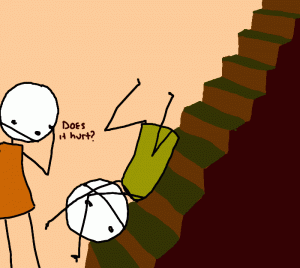
Once, when I was at dinner in a quasi-formal restaurant with a bunch of friends, we got on the subject of tattoos.  There were some debate about who had one, who wanted one and who wouldn’t be caught in hell with one.  The conversation steered towards the pain and the needles involved.  One of my friends, a State Trooper, mentioned casually he doesn’t like needles or anything blood related, in fact, the mere mentioning of either topic causes him to feel queasy.  With three to four years of Trooper experience, he’s a tall guy, at least 6’3, probably around 200 pounds, teetering on the slippery edge of being thirty, not overly muscular, but no couch potato either.   Sitting at the end of the table, he pleaded softly for us to change the topic.  Not taking him seriously, I carried on how the needles really didn’t hurt, how it felt like someone pressing the bristles of a hairbrush against my skin and that’s when it happened.  My friend’s eyes rolled back into his head like stuck numbers on a slot machine.  Before we could grab him, he fell face forward, intimately going to first base with the shag carpet.  His face dug deep in the carpet while his body teepeed up with his rear end flashing us.  Imagine a giant upside down V.  Of course, we all jumped up and ran to his side, flipped him over and began slapping his face.  His eyelids fluttered like the quick beats of a moth’s wings.  As he came to, he muttered incoherently, “What happened? Where am I?”  “On the floor,” I said, “You passed out”.  With the help of some cold water, he regained consciousness.  We quickly paid the bill, pulled the car around and carried him out.  Afterwards, he had a huge strawberry that skunk tailed down the front of his face.  He told his co-workers he got smacked with a branch while working in the yard.

The whole time I was in stitches.  First, the image of him – a State Trooper, face smooching carpet, ass up in the air – was hysterical.  Second, him lying supine in the middle of the restaurant, diners huddled over, managers frantically wanting to call 911 was something out of a comedy.  Third, because of his size, everything was exaggerated – the dramatic fall, the awkward positioning, the hunched over rescue.  Afterwards, each time I saw him, I would imitate a redwood tree falling.  Knee slapping, eyes watering, I would guffaw like a barking seal when I was done.  He didn’t find it very amusing, nor did my other friends.  You are evil, they told me.

When I went back home to Vietnam, my reserved cousins were absolutely shocked at my brazen laughter.  When one almost tumbled into the creek, I was doubled over in hysterics.  When she straightened herself out, she looked at me and said, “How can you life at the misery of others?”  Hmmm, easily I thought.

But I’ve gotten better.  I have controlled my fits of laughter so that I don’t bust a gut immediately.  For instance, a couple of months ago, I was washing my hands in the bathroom, when a man, using the urinal, lost his pants.  I don’t mean lost as in he couldn’t locate them, but lost as in the middle of relieving himself, his pants plunged to the floor.  I couldn’t see the reaction on his face nor could he see mine since he was facing the wall.  For that, I was grateful because I was desperately trying to suppress my reaction.  Another man came in, stopped and did a double take when he saw the underwear-clad man.  He saw me and tilted his head towards the semi-naked man, I shrugged, feigning ignorance.  I left as the man bent down to lift his pants back up.  I barely contained my laughter as I walked out.

I think Miss Manners would probably advise us to ignore these situations and pretend they didn’t happen, but that’s easier said then done.  Don’t get me wrong, I don’t exclude myself when I fall or trip.  If I take a tumble, I’m the first one hunched over laughing afterwards.  It’s funny.  It’s the reason why videos of people nose diving or ass cracking are the most watched videos on the Internet.  C’mon admit it, you chucked a little, if not a lot, when you imagined my friend with his face buried in the carpet and ass to the ceiling.  It’s ok if you did, he’ll never know and trust me, I won’t tell.  We’ll just make it our little secret.

Share

Catfish and Mandala

0374119740

Catfish and Mandala, a memoir by Andrew Pham, details the journey of a Vietnamese American struggling to reconcile his Vietnamese heritage with his American ideologies.  Born in Saigon in 1967, Pham was raised in a moderately affluent household by Vietnamese standards.  His parents are educated, notably his father who is fluent in French and English.  Pham is the oldest son, the second of five children.  With middle class standing, his parents manage to secure some financial stability.  After the war, his family lost everything.  In 1977, he and his family narrowly fled Vietnam.  Pham was only viagra online no prescription buy viagra in us ten.  In his memoir, he voyages back to Vietnam in an attempt to rediscover his Vietnamese identity and more importantly, to harmonize his American identity with his Vietnamese past.

nolvadex online

Virtually destitute, Pham’s emotional return to Vietnam is not typical of a viet kieu, a Vietnamese living abroad. Where as most viet kieu travel back to Vietnam laden with gifts and cash, Pham is empty-pocketed with barely enough money to sustain him.  In addition, his choice to travel through Vietnam by bicycle absolutely stuns his relatives. He battles crippling dysentery, numbing fatigue and debilitating hunger during his trek from Saigon to Hanoi. Traversing the varied terrains of Vietnam on his bicycle, Pham visits his childhood haunts. Each visit triggers a torrent of emotions. Pham discovers most of his childhood stamping grounds have been relinquished to squalor or urban development.  While the topography tests his physical endurance, it is the natives who test his spirit and resolve. Pham encounters distant relatives, devious tour guides, street urchins and ominous ruffians.  Each encounter takes an emotional toll.  In this journey of self-discovery and renewal, Pham comes to terms with his past, his identity and most importantly, his place in this world.

Pham’s descriptive details are awe-inspiring.  He describes each scene like an artist painting with vivid colors.  The images jump off the pages and the reader is immersed in a culture steeped with tradition, contradictions, irony and admiration.  This is not a typical travel memoir describing beautiful sunsets and charming resorts. Pham’s memoir is intimate, raw and honest. In his story telling, he is not biased towards Vietnam nor is he prejudicial towards America.  His unique perspective as a Vietnamese American allows him to view Vietnamese culture as an insider as well as an outsider.  He understands the language, the customs and the mindset of the Vietnamese people. On the other hand, his American upbringing allows him to disengage and contrasts Vietnamese values with his American ones.  It is this dichotomy that makes his story so engaging.

Pham writes with such clarity he transforms the reader from a passive observer to an active traveling companion.  The reader experiences Pham’s every emotion, struggle and accomplishment.  The key to this connection is that the reader trust Pham’s account.  His description of the Vietnamese people and culture surpasses his memory and familial recollections.  His rich details of the history and topography of each city he visits are proof of his diligent research.  His inclusion of local points of interest personalizes each place making each one memorable and enduring to the reader.  This book is more than a travelogue; it’s an intimate diary of discovery.

In his memoir, Vietnam is portrayed through Pham’s eyes. Uncensored and unobstructed, there are times when this view is abrasive and unsettling.  However, it is important he includes this seedier side of Vietnam.  If Pham’s homecoming only consists of embracing family reunions then this book loses its refreshing honesty.  It is this honesty that draws the reader in.  The reader is engrossed in Pham’s day-to-day trials and tribulations.  Pham makes the reader squirm in reaction to his swallowing a snake’s heart then makes the reader cheer when he stands up to local bullies and con artists.  The fact his stories evoke an emotional response from his readers is a trademark of a skilled writer.

Pham’s choice to travel on bicycle speaks of his unconventionality.  It is poignant he chooses a mode of travel that is inherently difficult.  His physical struggle parallels his emotional one.  When his physical perseverance is taxed to the limit, his emotional tenacity concurrently wanes.  Whether on purpose or happenstance, Pham chooses the most common mode of travel in Vietnam but the least utilized in America to retrace his heritage.  As an American, the assumption would be that he travels by vehicle or have professional guides help him.  Instead, Pham’s solo two-wheeled journey connects him on a grass roots level to a country he is longing to belong.  The story would lose its appeal if Pham had been chauffeured to the origins of his childhood memories.

Pham weaves stories of his family throughout his memoir, notable the story of his older sister, Chi. The conflict of reconciling one’s culture with one’s identity is profoundly illustrated with his sister’s own turmoil.  Being the first-born and a female, his sister’s life commences as a disappointment to her father.  It was not until she had a sex change did she receive some acknowledgement from her father.  However, acknowledgement is not the same as acceptance.  Alienated and depressed, Chi commits suicide.  Her family later dubs her suicide as an accident.  She started her life feeling like an accident and ended her life as one.  Chi’s struggle of acceptance and belonging is the same undercurrent that motivates Pham’s journey back to Vietnam.

The charm of this book lies in the vivid details.  Pham’s story telling is succinct but in that brevity he packs in a tremendous amount of information. The reader trusts Pham’s authority on Vietnamese culture.  He writes in a confident and assured voice.  His writing is universal in that readers unfamiliar with Vietnamese culture can still understand and follow the story’s progression.  While Asian, especially Vietnamese, readers can relate and compare Pham’s experiences with their own.

Share

Agony of Defeat

sorrow

This is where it happened.

legitimate payday loan consolidation

What happened, I asked?  Did something bad happen?

Yes. Somebody died here.

Who died?  Who got killed?

With deep hesitation, she looked at us and said, Your grandfather.

My brother and I stared at her in disbelief.

?  Our word for mother in Vietnamese.

This is where the loving man I knew as a child died and, here in his place, a sad, remorseful man was born. This is where the Viet Cong had your grandfather brutally beaten.

During the war, the Viet Cong illustrated their might by having respected members of the community publicly beaten.  As if the beatings were not humiliating enough, the Viet Cong forced neighbors to carry out these beatings.  With the bravado of militant gang members, they effectively demoralized the village leaders.  Once the leaders were subdued, they knew the people would be easier to control.

In the early 1950’s, the Viet Cong began to dominate the northern provinces.  They particularly targeted small local villages where the weak defenses made them easy prey.  My mother’s hometown of Thien Hien was no exception.  After squelching all resistance, the Viet Cong began to select distinguished village members to harass.  In my mother’s poor village, my family had some modest repute.  My grandfather was the son of the village’s equivalent to a mayor.  His status made him the prime target of the Viet Cong.  It was only a matter of time before they made an example out of him.

My mother remembers the day the Viet Cong invaded their home with mob-like ferocity and strong-armed my grandfather out of the house.  They forced him to kneel execution style on the sidewalk.  Then, they coerced his neighbors onto the streets.  Once outside, the neighbors solemnly encircled him like mourners at a funeral.  One by one, they were shoved in front of him.  Manipulated like marionettes, each villager was forced to slowly lift my grandfather’s chin with one hand and then quickly slapped him with the other.  His face was raised each time so he would have to stare into each neighbor’s eyes before and after each strike.  If the villagers were too lenient or soft handed in their blows, the Viet Cong made them do it again until they were satisfied with the severity.  If he fell to the ground, he was propped back up in his kowtowed position.

Powerless to stop it, my mother and the rest of the family stood on the perimeter clutching each other for comfort.  She watched in anger and disbelief at his defilement.  He didn’t cry out or lash back.  He knelt in complete silence accepting the fate delivered to him.

In the aftermath, his cheeks were dyed crimson from the many blows he endured.  His hair mangled and frayed like steel wool.  His head bent so low his chin rested on his chest.  His blackened eyes no larger then small slits.  Thick, syrupy blood oozed out of the hollows of his nose.  His swollen lips unable to hinder the cerise saliva spooling out of his mouth.  His gnarled knees bloodied from continually scraping the cement as he tried to balance himself during each blow.  His hands clinched tight ballooning the leafy veins in his arms.  Shoulders, once jauntily dignified, now stooped in relinquished defeat.

The same hands that delivered the punishing blows were now lifting him up and carrying him home.  Apologies were made but my grandfather said nothing.  Once inside, my mother cleansed and bandaged his wounds.  He didn’t breathe a word.  Staring blankly in front of him, he sat inert and leaden.  She saw the emptiness in his eyes and felt his hands quiver like viagra order no prescription a cautious flame.  She set out to console him with an embrace but he slowly turned away from her like someone trying to hide his tears.  With strenuous effort, he laid down, turned to face the wall, and closed his eyes.

Share

The Beheading

Fear

payday loan trouble
The tension between my family and the Viet Cong was as thick as the dense jungle landscape surrounding my mother’s village.  The animosity had been fermenting since the Viet Cong first started to persuade residents of my mother’s village to join their cause.  Spewing credos of communal brotherhood, they initially appealed to the destitute villagers.  But soon after, their sense of community changed to one of entitlement.  They started to harass the female villagers and bullied the older ones.  They pillaged goods from the local shops taking whatever they wanted.  In addition to free meals and housing, they insisted on weekly payments from the destitute village.

easy to get payday loan

When dissenters voiced their concerns, the Viet Cong tried to swiftly quash any resistance with brutal force.  But they were still recruiting and didn’t always have the numbers to quell all the dissidents.

During one fateful skirmish, the confrontation escalated to a violent clash.  As fast as milk tans coffee, the scene erupted into a vicious battle.  In the end, most of the Viet Cong fled for their lives; however, one was left behind.

His dead body lay broken among the high grass.  No one knew his name.  Such was the impression the Viet Cong made on the villagers that the corpse was immediately decapitated.  The severed head was then paraded around the village like a victory banner.  With pride and conviction, the man marching through the streets with the detached head established his reputation that day.  That man was my uncle, Bac Noan.

As my mother’s older brother, his title Bac translates to elder uncle.  Reserved and stoic, he usually kept to himself and restricted any conversation to nods and headshakes. His hands were strong and calloused from the many years working as a carpenter.  My mother remembers him as a strict disciplinarian who would often cane her when she misbehaved.

He inherited my grandmother’s stubborn facial features.  The lines underneath his eyes were like worn cracks in the pavement.  On the rare occasion he laughed, the tips of his eyelids would smile upwards.  He had a soft nose that was barely distinguishable and his ears fanned out like the sails on a boat.

Growing up, I remembered my uncle strayed away from large crowds.  He was usually found on the fringes with his arms folded tightly across his chest.  Short in stature, he had a thin, wiry frame.  His arms and legs resemble the slender spokes of a wheel.  He skulked during family gatherings and preferred to eat at the kid’s table.  The times he was thrust into the spotlight, he behaved like an actor auditioning for an un-rehearsed role. Attention to him was like a swarm of angry assaulting bees, relentlessly stinging his vulnerability.

He didn’t believe in status or fame and always had deep creases in his brow unveiling his persistent concentration.  His lips were constantly pursed.  He adhered to traditional Vietnamese principles and lived his life accordingly.

The only times he was stirred into action was when his principles were compromised. Provocation was the last thing he wanted, but when his beliefs were challenged, he cast off his inhibitions and became a man compelled to action.

Share