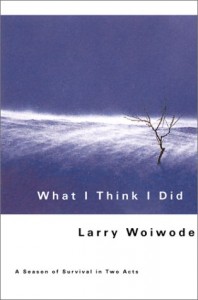
What I Think I Did

41CPSC1ESTL

This is not an actual review but a question posed to me about Woiwode’s experience as a novice writer in his book, What I Think I Did.

As a novice writer, I felt such kinship reading about Woiwode’s struggles and triumphs as a writer.   There are two statements Woiwode writes that encapsulate the hurdles of a young writer,  because the search for words in a beginning writer is as elusive as the search for physical expression (p.209) and What a writer often needs, and especially a beginner, is an answer to technical difficulties. (p.259)  Woiwode definitely got an amen from me as I read those passages.  I find that as I write, or in many cases try to write, I am searching for those words that easily slip off my tongue but find difficulties finding their way home on a blank page.  Forget horror movies, a blank page is the scariest thing for me.  Then there are the questions that creep up, the technical ones.  I can see the image in my head but how do I translate that image to words with the same technicolor magic?   I feel that I often overkill with details and as Scouffas tells Woiwode I over-reach.  But on the flip side, I feel that if I simplify things then I’m losing the intensity of the scene.

I think we all unilaterally regressed back when we read the passage about Woiwode’s experience of rejection when he turned in his first writing submission.  I’m breathless, as eager amateurs are, though they have the confidence of peacocks in displaying themselves€  (p.124)  It’s doesn’t matter whether it’s your first rejection or your tenth one, the sting still hurts.  Even as a more experienced writer, Woiwode received harsh but critical reviews, Larry, either my judgment is failing me or this the worst thing you’ve ever written.  (p. 186)  Ouch.  But as the old adage goes, what doesn’t kill us, makes us stronger.  I could write a book on rejection and feelings of inadequacies.  Hmmm…

I think the best advice given to Woiwode on learning how to write is the ever-present question, Isn’t there a simpler way of saying that. (p.259)  For me, this has become my mantra, my chant, and my meditation.  As I am learning the nuances of good writing, I find that the Zen approach to writing, less is more, is pervasive.  You don’t have to look no further then Tobias Wolff’s This Boy’s Life for a beautiful example.  What I’m struggling with is finding the balance, trying to get my point or the image across like a haiku but without losing the intensity of emotions.  More often than not, I feel as I edit my work, I feel as if I losing my children in the process.  I just got to learn to let go.

server crawl test .

Share

The Beheading

Fear

payday loan trouble
The tension between my family and the Viet Cong was as thick as the dense jungle landscape surrounding my mother’s village.  The animosity had been fermenting since the Viet Cong first started to persuade residents of my mother’s village to join their cause.  Spewing credos of communal brotherhood, they initially appealed to the destitute villagers.  But soon after, their sense of community changed to one of entitlement.  They started to harass the female villagers and bullied the older ones.  They pillaged goods from the local shops taking whatever they wanted.  In addition to free meals and housing, they insisted on weekly payments from the destitute village.

easy to get payday loan

When dissenters voiced their concerns, the Viet Cong tried to swiftly quash any resistance with brutal force.  But they were still recruiting and didn’t always have the numbers to quell all the dissidents.

During one fateful skirmish, the confrontation escalated to a violent clash.  As fast as milk tans coffee, the scene erupted into a vicious battle.  In the end, most of the Viet Cong fled for their lives; however, one was left behind.

His dead body lay broken among the high grass.  No one knew his name.  Such was the impression the Viet Cong made on the villagers that the corpse was immediately decapitated.  The severed head was then paraded around the village like a victory banner.  With pride and conviction, the man marching through the streets with the detached head established his reputation that day.  That man was my uncle, Bac Noan.

As my mother’s older brother, his title Bac translates to elder uncle.  Reserved and stoic, he usually kept to himself and restricted any conversation to nods and headshakes. His hands were strong and calloused from the many years working as a carpenter.  My mother remembers him as a strict disciplinarian who would often cane her when she misbehaved.

He inherited my grandmother’s stubborn facial features.  The lines underneath his eyes were like worn cracks in the pavement.  On the rare occasion he laughed, the tips of his eyelids would smile upwards.  He had a soft nose that was barely distinguishable and his ears fanned out like the sails on a boat.

Growing up, I remembered my uncle strayed away from large crowds.  He was usually found on the fringes with his arms folded tightly across his chest.  Short in stature, he had a thin, wiry frame.  His arms and legs resemble the slender spokes of a wheel.  He skulked during family gatherings and preferred to eat at the kid’s table.  The times he was thrust into the spotlight, he behaved like an actor auditioning for an un-rehearsed role. Attention to him was like a swarm of angry assaulting bees, relentlessly stinging his vulnerability.

He didn’t believe in status or fame and always had deep creases in his brow unveiling his persistent concentration.  His lips were constantly pursed.  He adhered to traditional Vietnamese principles and lived his life accordingly.

The only times he was stirred into action was when his principles were compromised. Provocation was the last thing he wanted, but when his beliefs were challenged, he cast off his inhibitions and became a man compelled to action.

Share