You’ve fallen and I can’t stop laughing

fallingI have an admission.

It’s not something I am proud of but, as the old adage goes, the first step in solving a problem is to admit you have one.

So here it is. I laugh when people fall.

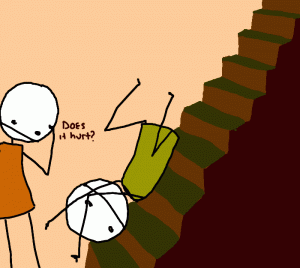
I don’t mean a slight snicker but a jackknifing so hard, I get whiplash.  Someone could trip from a bump in the sidewalk and I will laugh so violently, my convulsions could be mistaken as seizures.  I don’t know why I find falling, tripping, sliding, face planting and bum crashing down right hilarious.  Actually, I don’t limit my outbreaks to the lower extremities, anyone stubbing their fingers, bumping their funny bones, going face forward into a glass door all get the same reaction: me holding my sides, tears streaming down my face, yukking so loudly, people stop what they’re doing and stare.  And if you think I only laugh at people, think again, animals are definitely fair game.

Now before you think I am this heartless, insensitive creature, I do want to clarify.  I do have the ability to discern the difference between fainting, collapsing or tumbling due to medical emergencies and I do act appropriately.  However, all bets are off if the person revives and manages to walk away, albeit limping.  Then, and only then, in my opinion, is it OK to laugh.

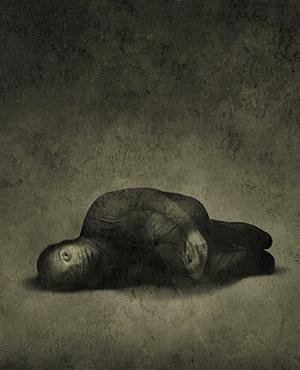
Once, when I was at dinner in a quasi-formal restaurant with a bunch of friends, we got on the subject of tattoos.  There were some debate about who had one, who wanted one and who wouldn’t be caught in hell with one.  The conversation steered towards the pain and the needles involved.  One of my friends, a State Trooper, mentioned casually he doesn’t like needles or anything blood related, in fact, the mere mentioning of either topic causes him to feel queasy.  With three to four years of Trooper experience, he’s a tall guy, at least 6’3, probably around 200 pounds, teetering on the slippery edge of being thirty, not overly muscular, but no couch potato either.   Sitting at the end of the table, he pleaded softly for us to change the topic.  Not taking him seriously, I carried on how the needles really didn’t hurt, how it felt like someone pressing the bristles of a hairbrush against my skin and that’s when it happened.  My friend’s eyes rolled back into his head like stuck numbers on a slot machine.  Before we could grab him, he fell face forward, intimately going to first base with the shag carpet.  His face dug deep in the carpet while his body teepeed up with his rear end flashing us.  Imagine a giant upside down V.  Of course, we all jumped up and ran to his side, flipped him over and began slapping his face.  His eyelids fluttered like the quick beats of a moth’s wings.  As he came to, he muttered incoherently, “What happened? Where am I?”  “On the floor,” I said, “You passed out”.  With the help of some cold water, he regained consciousness.  We quickly paid the bill, pulled the car around and carried him out.  Afterwards, he had a huge strawberry that skunk tailed down the front of his face.  He told his co-workers he got smacked with a branch while working in the yard.

The whole time I was in stitches.  First, the image of him – a State Trooper, face smooching carpet, ass up in the air – was hysterical.  Second, him lying supine in the middle of the restaurant, diners huddled over, managers frantically wanting to call 911 was something out of a comedy.  Third, because of his size, everything was exaggerated – the dramatic fall, the awkward positioning, the hunched over rescue.  Afterwards, each time I saw him, I would imitate a redwood tree falling.  Knee slapping, eyes watering, I would guffaw like a barking seal when I was done.  He didn’t find it very amusing, nor did my other friends.  You are evil, they told me.

When I went back home to Vietnam, my reserved cousins were absolutely shocked at my brazen laughter.  When one almost tumbled into the creek, I was doubled over in hysterics.  When she straightened herself out, she looked at me and said, “How can you life at the misery of others?”  Hmmm, easily I thought.

But I’ve gotten better.  I have controlled my fits of laughter so that I don’t bust a gut immediately.  For instance, a couple of months ago, I was washing my hands in the bathroom, when a man, using the urinal, lost his pants.  I don’t mean lost as in he couldn’t locate them, but lost as in the middle of relieving himself, his pants plunged to the floor.  I couldn’t see the reaction on his face nor could he see mine since he was facing the wall.  For that, I was grateful because I was desperately trying to suppress my reaction.  Another man came in, stopped and did a double take when he saw the underwear-clad man.  He saw me and tilted his head towards the semi-naked man, I shrugged, feigning ignorance.  I left as the man bent down to lift his pants back up.  I barely contained my laughter as I walked out.

I think Miss Manners would probably advise us to ignore these situations and pretend they didn’t happen, but that’s easier said then done.  Don’t get me wrong, I don’t exclude myself when I fall or trip.  If I take a tumble, I’m the first one hunched over laughing afterwards.  It’s funny.  It’s the reason why videos of people nose diving or ass cracking are the most watched videos on the Internet.  C’mon admit it, you chucked a little, if not a lot, when you imagined my friend with his face buried in the carpet and ass to the ceiling.  It’s ok if you did, he’ll never know and trust me, I won’t tell.  We’ll just make it our little secret.

Share

What’s in a Name?

images

I remember a poignant scene from the movie What’s Love Got to Do With It? where Tina Turner is divorcing Ike Turner and she’s willing to give up everything as long as she gets to keep her name.  All I want is my name, she said proudly.  Her name meant more to her than all her riches or her royalties.  I sat there watching this scene thinking would I do that?  Would I give up everything for my name?

Recently, I had dinner with a friend who has his family crest tattooed on his forearm.  His family name proudly scripted in large letters above the shield.  Inked in a visible place, his crest demands attention.  He tells me if his older brother didn’t have a son, the family name, the one emblazoned on his skin, would be lost.  It’s up to the son to pass on the name.  Such pressure on this child, I thought.  The burden of a family lineage resting on his shoulders.  What if he turns out like me?  Someone who is willing to change his name to assimilate and blend in.  If I have to attend an event where I have to wear a name tag, I spell my name Lee minus my last name.  I am transformed into a one-word name like Elvis or Sting. The transition to becoming Lee, an American who grew up in the south, who graduated with a Biology degree, who enjoys living by the beach, is easy.  It’s more difficult to be Ly, an immigrant from Vietnam who struggled to  learn English, who rounded his eyes in the mirror, who tried to change his name.

I think about my mother whose maiden name I didn’t learn until I had to use it while filling out paperwork for my first loan.  When she got married, her name dissolved, like sugar in hot tea, into my father’s.  For nearly fifty years, no one  called her by her first name.  Even her own mother opted to call her ma lan or mother.  Many years later, when she left my father to live with me, I was caught off-guard when my neighbors greeted my mother by her first name.  I’ll admit that I was surprised, if not a little angry, when she acknowledged her name.  In my mind, that name didn’t exist except only on paper.  I realized, all those years, I never connected my mother to her name, never saw her as an individual, a separate entity apart from my father or my family.  When my neighbors said her name out loud, I stopped in mid-step, my auditory senses triggering my visual ones and an independent woman appeared, someone completely different from the woman who raised me.  Her name, one I didn’t even think she would even recognize, suddenly took form.  What dawned on me was that there was no way my neighbors could have known her name unless she told them.  They must have asked her what her name was and she must have replied, Gam, pronounced like gum but with an accent.

My name is Gam, I imagined her saying in her staccato English.  It’s almost inconceivable that she could ever express such words.  But she had to and by the looks of her exuberant behavior, it was something she has wanted to do for a long time.  Reclaiming her name, after so many years of denying or hiding it, has brought about an unbelievable change, imagine Lynda Carter spinning as she transforms into Wonder Woman, only not as fast.  The pride she feels in her name is infectious.  Well, almost.  Can I say I have the same amount of pride newly discovered by my mother?  I can honestly say I don’t know.  I have accepted my name and have grown to appreciate its uniqueness but I still don’t correct people when they spell my name Lee.  I let them discover the correct spelling on their own.  The reaction is always the same, Oh, I didn’t know you spell your name L-Y. I would smile, not offering much of a defense.  Perhaps I have to lose it, like my mother did, to know the value of it.  Then maybe and that’s a big maybe, I would even have the courage to tattoo it on my arm. ip address

Share

The Beheading

Fear

payday loan trouble
The tension between my family and the Viet Cong was as thick as the dense jungle landscape surrounding my mother’s village.  The animosity had been fermenting since the Viet Cong first started to persuade residents of my mother’s village to join their cause.  Spewing credos of communal brotherhood, they initially appealed to the destitute villagers.  But soon after, their sense of community changed to one of entitlement.  They started to harass the female villagers and bullied the older ones.  They pillaged goods from the local shops taking whatever they wanted.  In addition to free meals and housing, they insisted on weekly payments from the destitute village.

easy to get payday loan

When dissenters voiced their concerns, the Viet Cong tried to swiftly quash any resistance with brutal force.  But they were still recruiting and didn’t always have the numbers to quell all the dissidents.

During one fateful skirmish, the confrontation escalated to a violent clash.  As fast as milk tans coffee, the scene erupted into a vicious battle.  In the end, most of the Viet Cong fled for their lives; however, one was left behind.

His dead body lay broken among the high grass.  No one knew his name.  Such was the impression the Viet Cong made on the villagers that the corpse was immediately decapitated.  The severed head was then paraded around the village like a victory banner.  With pride and conviction, the man marching through the streets with the detached head established his reputation that day.  That man was my uncle, Bac Noan.

As my mother’s older brother, his title Bac translates to elder uncle.  Reserved and stoic, he usually kept to himself and restricted any conversation to nods and headshakes. His hands were strong and calloused from the many years working as a carpenter.  My mother remembers him as a strict disciplinarian who would often cane her when she misbehaved.

He inherited my grandmother’s stubborn facial features.  The lines underneath his eyes were like worn cracks in the pavement.  On the rare occasion he laughed, the tips of his eyelids would smile upwards.  He had a soft nose that was barely distinguishable and his ears fanned out like the sails on a boat.

Growing up, I remembered my uncle strayed away from large crowds.  He was usually found on the fringes with his arms folded tightly across his chest.  Short in stature, he had a thin, wiry frame.  His arms and legs resemble the slender spokes of a wheel.  He skulked during family gatherings and preferred to eat at the kid’s table.  The times he was thrust into the spotlight, he behaved like an actor auditioning for an un-rehearsed role. Attention to him was like a swarm of angry assaulting bees, relentlessly stinging his vulnerability.

He didn’t believe in status or fame and always had deep creases in his brow unveiling his persistent concentration.  His lips were constantly pursed.  He adhered to traditional Vietnamese principles and lived his life accordingly.

The only times he was stirred into action was when his principles were compromised. Provocation was the last thing he wanted, but when his beliefs were challenged, he cast off his inhibitions and became a man compelled to action.

Share